Trading Confluences That Actually Improve Entries
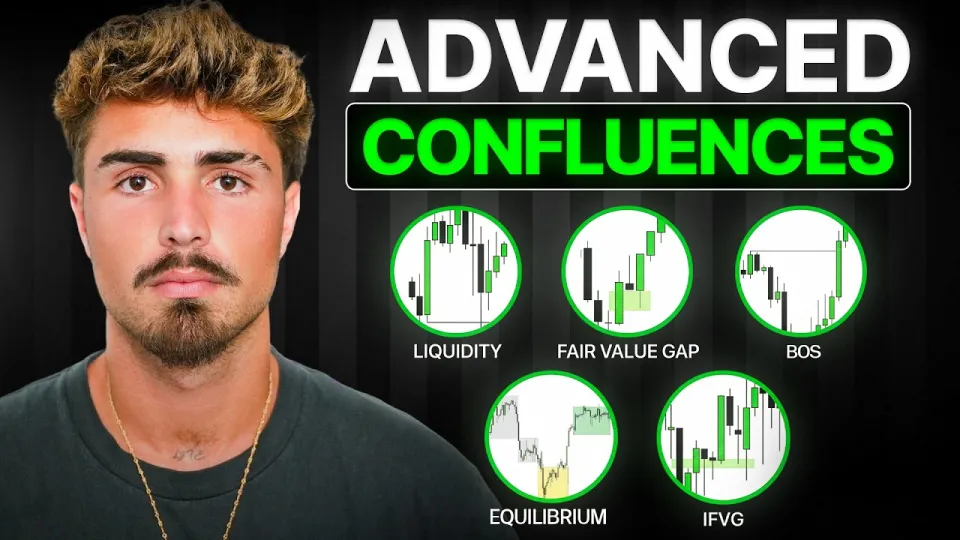
Video: Learn Every Trading Confluence In 18 Minutes
Need articles like this for your video? They help promote it on YouTube and Google — order them in the Telegram bot @sat_sit_bot. It writes articles around your video, embeds the video and publishes them on popular niche websites (no ads). Your first 50 articles are free.
· based on the channel TJR
Key takeaways
- A confluence is any independent piece of evidence that supports a trade idea; more signals do not automatically mean a better setup.
- The core set covered in TJR's 18-minute breakdown: liquidity, fair value gap (FVG), inverse FVG, equal highs/lows, and break of structure (BOS).
- Confluences stack in a hierarchy: higher-timeframe context and liquidity come first, entry-level signals such as an FVG come last.
- Two or three aligned signals are usually enough; adding more mostly adds confirmation bias, not edge.
- Every confluence still needs a defined invalidation level and a risk-reward check before the trade is taken.
Trading confluences are independent pieces of evidence — a liquidity sweep, a fair value gap, a break of structure — that line up to support one trade idea. Used well, they filter out weak setups and tell you where to enter, where to place a stop, and when to skip the trade entirely. TJR's 18-minute walkthrough of the main confluence types is a useful checklist for building that filter, and the same framework is outlined in the free trader blueprint at the TJR blueprint page.
What a confluence actually is in trading
A confluence is any factor that is logically separate from your primary signal but points the same way. Two moving averages crossing is one idea, not two confluences; a liquidity sweep, a higher-timeframe level and a fair value gap are three different ideas, and that is what makes stacking them meaningful. The practical value is not in collecting signals but in ranking them: some confluences describe where price is likely to react, others only describe how it has already moved. The first group deserves more weight.
A workable hierarchy looks like this:
- Context — the higher-timeframe trend, range boundaries, and the session you are trading.
- Liquidity — where resting orders sit above equal highs or below equal lows, and whether price has already taken them.
- Structure — break of structure (BOS) or a change of character that confirms the direction.
- Entry-level signals — fair value gaps, inverse fair value gaps, and order blocks that give you a precise price to act on.
- Risk — stop placement behind the invalidation point and a minimum reward-to-risk ratio.
If a setup fails at step one or two, the entry-level signals at step four are irrelevant, no matter how clean they look on a lower timeframe.
Liquidity, fair value gaps and structure in practice
Liquidity is the anchor of the whole framework: price tends to move toward pools of stop orders and then react after taking them. Equal highs and equal lows are the most visible version — traders park stops just beyond them, and a sweep through that level often precedes a reversal. A fair value gap is a three-candle imbalance where the wicks of the first and third candle do not overlap, leaving a zone price frequently returns to before continuing. An inverse fair value gap is the same zone after price has traded through it and it flips role, acting as support where it previously acted as resistance, or the other way around. A break of structure confirms direction when price closes beyond a prior swing high or low in the direction of the intended trade.
The sequence matters more than the individual pieces: liquidity gets taken, structure breaks, price returns into the gap, and the trade is entered with a stop on the far side of the zone. That is one coherent story rather than five unrelated indicators agreeing by accident.
How many confluences are enough
Two or three aligned confluences are typically enough to justify a trade, provided one of them is liquidity or higher-timeframe context. Requiring five or six sounds rigorous but usually produces one of two bad outcomes: either you never take a trade, or you keep adding signals until a setup you already wanted to take looks justified. The second failure is more expensive, because it feels like discipline. A simple rule helps: name the confluence that would make you wrong, and if you cannot name it, you do not have a setup — you have an opinion.
A practical filter for any candidate trade:
- At least one confluence from the context or liquidity group.
- One entry-level confluence that defines the price you act at.
- A clear invalidation level within a distance your position size can absorb.
- A reward-to-risk ratio you would accept before seeing the outcome.
Common mistakes when stacking signals
Most losses blamed on confluences come from mixing timeframes without saying so. A fair value gap on a one-minute chart inside a strong five-minute downtrend is not a bullish confluence; it is noise inside a trend. The second common error is treating an indicator as a separate confluence when it is a transformation of price — an oscillator derived from the same candles does not add independent evidence. The third is entering before the confirmation you claim to require, then retroactively labelling the setup as complete.
A short checklist catches most of these:
- State the timeframe of every confluence you are counting.
- Remove any signal that is mathematically derived from another one on your list.
- Wait for the trigger candle to close before calling a gap inverse or a structure broken.
- Log the trade with the confluences you actually had, not the ones you remember having.
What traders usually ask about confluences
Viewers of TJR's breakdown tend to raise the same doubts: whether more confluences mean a higher win rate, how to trade when signals conflict, and whether any of this survives contact with a live account. The honest answer is that confluences improve selectivity, not certainty. A five-signal setup can still lose, and a two-signal setup can still win; what changes is how often you take low-quality trades and how consistently you can define risk. Traders who journal their setups quickly notice that their best results cluster around a small number of repeatable combinations rather than the maximum number of stacked factors. The discipline to skip the rest is the part that takes longest to build, and it is the part that most educational content skips.
Useful links
- Full trader blueprint: https://go.tjrtrades.com/blueprint-nviugv1
- Indicators used daily: https://go.tjrtrades.com/indicators-6qf6zb4
- Funded account raffle: https://form.tjrtrades.com/funded-contest
- Alpha Futures funded accounts, 10% off: https://app.alpha-futures.com/signup/TJR/
- Lucid Trading, 40% off: https://lucidtrading.com/ref/TJR/
- Tradeify funded accounts, 30% off: https://tradeify.co/?ref=PBCGEZAG
- Trading journal: https://tradezella.com/?fpr=tjr
- Broker: http://herofx.co/tjr
Bottom line
Confluences are a filtering tool, not a prediction engine: liquidity, fair value gaps, inverse gaps, equal highs and lows, and break of structure each answer a different question about a setup. Rank them, require two or three that are genuinely independent, and define invalidation before entry. TJR's 18-minute overview on the TJR channel is a compact reference for the core set, and the blueprint is the place to start if you want the full process rather than the vocabulary. Trading is risky and most day traders lose money, so treat any confluence framework as a way to manage risk, not a promise of returns.
Questions & answers
Do more confluences mean a higher win rate?
Not automatically. Confluences improve selectivity by removing weak setups, but each additional signal adds less than the previous one and can turn into confirmation bias. Two or three genuinely independent factors, including liquidity or higher-timeframe context, are usually enough to define a trade and its invalidation level.
What is the difference between a fair value gap and an inverse fair value gap?
A fair value gap is a three-candle imbalance where the wicks of the first and third candle do not overlap, leaving a zone price often revisits. An inverse fair value gap is that same zone after price has traded through it and it flips role, so former resistance can act as support or the reverse.
How do I handle a setup where the confluences disagree?
Give priority to the higher timeframe and to liquidity, and drop the trade if the entry-level signal contradicts them. A bullish gap on a one-minute chart inside a strong bearish trend is noise, not a confluence. If you cannot name the level that would prove you wrong, skip the setup.
How long does it take to trade confluences consistently?
There is no fixed timeline, and results depend on screen time, journaling and risk control rather than on how many concepts you have watched. Most traders need months of logged trades to see which combinations actually work for them. Expect losses along the way, since day trading is risky and most day traders lose money.
Source: Learn Every Trading Confluence In 18 Minutes · Markdown version